
How to install a wood burning stove

Have you ever wondered what the process of installing a wood burning stove or multifuel stove into a chimney breast in your property would be? Generally this work would be carried out by a qualified installer (Hetas or other authorised organisations) or can be carried out by a competent person in conjuction with Local Authority Building Control. So what is the process? Here is a summary of the work that would be carried out to bring that warmth into your home:
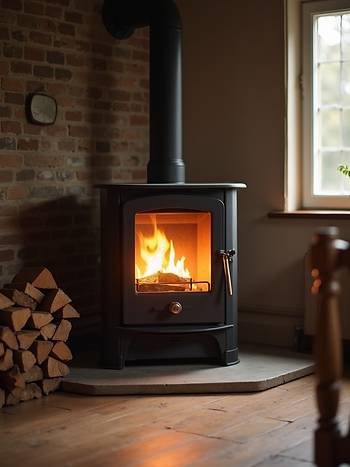
Step 1: Structural Preparation & Inspection to install a wood burning stove
Before going any further, you must verify the chimney’s integrity.
Sweep: The chimney will be swept to remove flammable creosote. A CCTV survey is recommended to check for "mid-feather" walls (the bricks separating your flue from a neighbour's).
The Opening: If your installer is enlarging the "recess" (opening), a concrete or steel lintel must be used to support the masonry above.
Distance to Combustibles: Any wooden beams or mantels must be at a safe distance. Document J states that a single-skin flue pipe must be 3x its diameter away from combustible material (e.g., a 150mm pipe needs 450mm clearance). Usually the pipe itself if hidden away within the recess but the top of the stove will be the part that may protrude and your installer will need to check that the distance from this is covered. This can be reduced to 1.5x if a non-combustible heat shield is used with a 12mm air gap. This can sometimes be reduced by the manufacturer of the stove after testing, so it is always worth asking your installer to check the manual for confirmation.
Step 2: The Hearth (Floor Protection)
The hearth protects your floor from heat and falling embers.
Constructional Hearth: If the stove's base exceeds 100°C (check the manual), you need a 250mm thick constructional hearth. This is rare with modern stoves but please advise the person installing the stove to check the stove manual for confirmation.
Superficial Hearth: If the stove is certified to keep the floor under 100°C, a 12mm non-combustible plate (slate, glass, etc.) is sufficient.
Dimensions:
Front: Must extend at least 225mm from the front of the stove when closed.
Sides: Must extend at least 150mm from the sides of the stove.
Step 3: Installing the Flue Liner
A flexible stainless steel liner is mandatory if the chimney is not perfectly gas-tight. Your installer will need to arrange for a pressure test to be performed on the chimney if you wish to not line the flue and only once this has been done and passed the test can the flue be used without a liner. Pressure testing is quite a pricey procedure and, in the end, many chimeny's fail so often it is cheaper just to use a liner from the beginning.
Select Grade: 316 grade steel liners are for wood only; 904 grade steel liners are required if you intend to burn smokeless coal. Let your installer know what your new model of stove is able to burn and they will be able to provide the correct liner.
Feeding the Liner: Your installer will attach a nose cone to the bottom of the liner and tie a long pull-rope to it. Feeding the liner from the roof down the chimney while an assistant pulls the rope from the fireplace will most likely be the easiest method to install the liner through the chimney. Some liners need to be installed in a specific direction. Make sure that you installer ensures the "flow arrows" on the liner point upwards up the chimney. Some brands, such as Dura Flue liners which we supply at www.onlinestoves.co.uk, are multi-directional so can be installed either way. Ask your installer to check with the supplier to confirm what is required for your liner.
Step 4: The Register (Closure) Plate
This plate seals the bottom of the chimney preventing the heat escaping straight up the void around the flue liner and stops any remaining soot in the chimney from falling onto the stove..
Material: Often installers will use a galvanized steel plate ora different non-combustable board such as cement board or vermiculite board (min 1.5mm thick for steel).
Fitting: The easiest way for your installer to secure the plate would be using angled iron bars and screwing the plate directly into them.
The Flue Hole: The installer wil cut a hole for the stove pipe. This is best done before trying to install the plate so they will need to measure where the hole will be required when the stove is in place and the plate is above. They will seal the gap between the pipe and the plate with high-temperature silicone or fire cement.
Step 5: Termination (The Top)
How the flue exits the building is critical for air pressure.
Chimney Pot: There are 2 possible methods that the installer could use. Your installer may suspend the liner at the top using a top plate and clamp that sits on the chimney stack before placing the chimney pot over the top and cementing it to the stack. Alternatively, they could use a pot hanging rain cap which is an 'all in one' method, where the liner is secured to the bottom of the cowl before it is placed onto the chimney pot and strapped on to secure. This method means that they do not need to remove and then resucure the chimney pot.
Cowl: They will fit a "Hanging Cowl" or "Bird Guard" to keep rain and birds out while allowing smoke to escape freely.
Step 6: Ventilation Requirements
Stoves need oxygen to burn; without it, they will draw air from the room, causing "starvation" and smoke leaks. Your installer will need to follow these rules:
Pre-2008 Houses: No vent needed for stoves under 5kW. For stoves over 5kW, you need 550mm2 of permanent ventilation for every kW over 5.
Post-2008 Houses: New builds are so airtight they require 550mm2 of ventilation for every kW of the stove's output, starting from 0.
Step 7: Safety & Testing
Once connected, your installer will perform two mandatory tests as per Document J:
Smoke Test 1 (Integrity): Block the top of the chimney and light a high-volume smoke pellet at the bottom. Check all floors and the loft for leaks.
Smoke Test 2 (Draw): With the stove connected, light a smoke pellet inside the firebox with the door slightly ajar. Ensure the smoke is "pulled" up the chimney immediately.
CO Alarm: A carbon monoxide alarm (BS EN 50291) must be permanently fixed between 1m and 3m from the stove, either on the ceiling or high up on a wall.
Notice Plate: If your installer is Hetas registered, they will fill out a permanent "Notice Plate" (detailing the flue size and hearth type) and fix it near the stove or in the electricity meter cupboard.
[!CAUTION]Carbon Monoxide Warning: Never use the stove for the first time without a working CO alarm. If you feel dizzy or have a headache while using a newly installed stove, extinguish the fire immediately and ventilate the room.
You must either use a HETAS-registered installer or notify Local Authority Building Control prior to the installation so they can inspect and certify the work.


Comments